Thought leadership
Small Satellites, Big Shift: How National Microsatellite Programmes Are Changing the Game for European Space
How Greece, Spain, and Portugal are building sovereign Earth Observation capabilities from the ground up
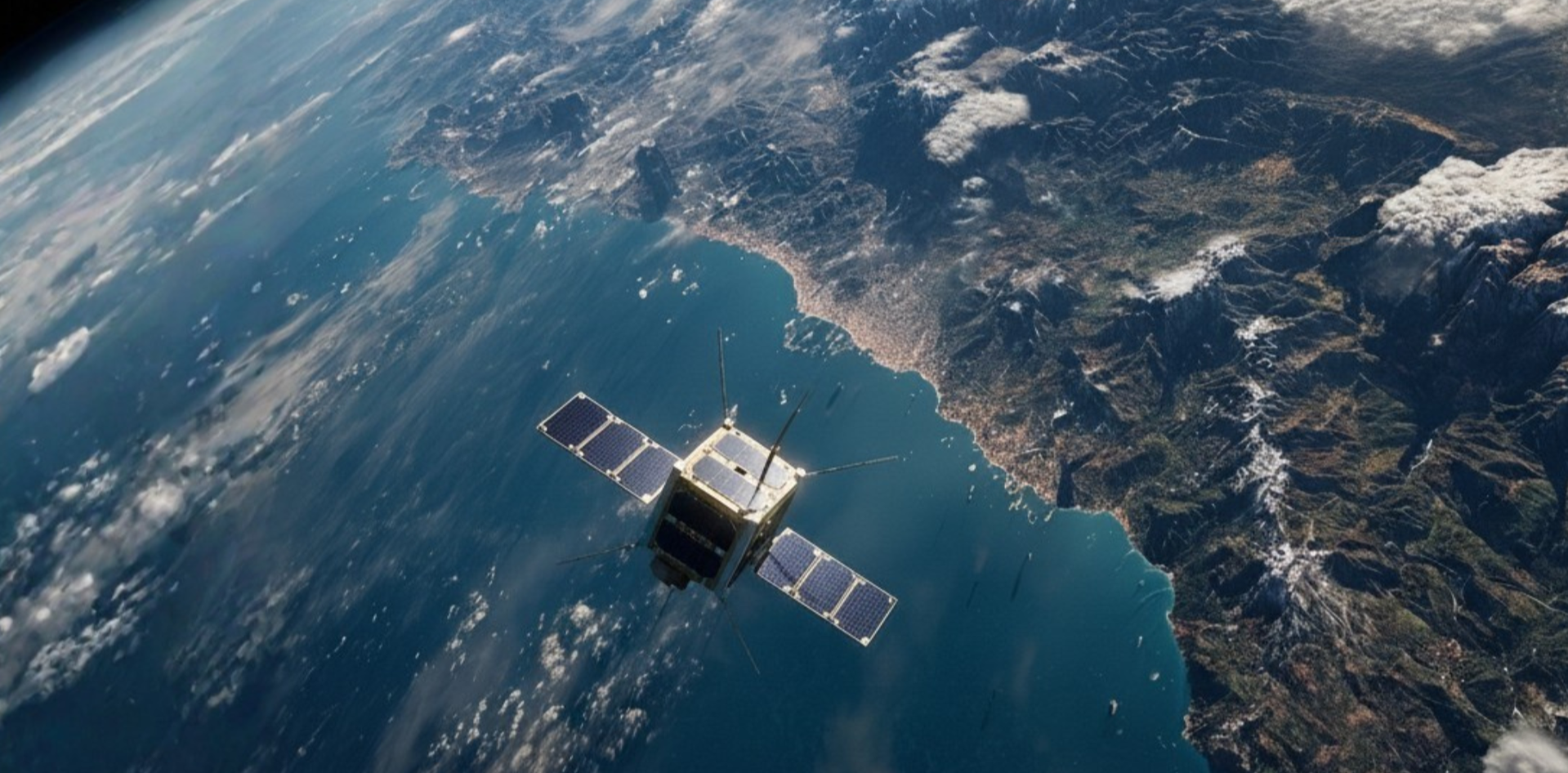
Illustration: AI-generated image of a microsatellite in low Earth orbit
On the 15th of January 2026, forty-eight days after launch, Greece's first operational Earth Observation microsatellites captured an image of the Hellenic Navy's new frigate Kimon sailing through the Saronic Gulf.
At launch, the Secretary General of Telecommunications and Post, Konstantinos Karantzalos, identified the moment as a turning point for the country's future: 'Greece will not be a simple user, but a producer and exporter of know-how in the aerospace field.'
Greece is not alone. Spain and Portugal are also building their own national microsatellite programmes, launching spacecraft, and establishing independent Earth Observation capabilities for the first time. None of these countries are traditional space powers or have large dedicated space budgets. And yet, they are putting satellites in orbit faster than some of Europe's flagship programmes.
A new era of autonomous, nationally-driven space capability is becoming a reality, and it may be the most underreported development in European space today.
What is being launched
Greece: sovereign data — and a reason for engineers to come home
Greece launched five satellites in November 2025 as the first step of its National Microsatellite Programme, a €200 million initiative designed by the Ministry of Digital Governance and Artificial Intelligence and funded through the EU Recovery and Resilience Facility. Two are operational Synthetic Aperture Radar (SAR) satellites built by ICEYE, providing Earth Observation data day and night, under any weather conditions. The other three are experimental: two from the Libre Space Foundation, demonstrating spectrum surveillance and secure connectivity, and one from Prisma Electronics in Alexandroupoli focused on Internet of Things connectivity and secure maritime communications.

© Greek National Microsatellite Programme / AMNA (cropped)
First light: Greece's microsatellites capture the frigate Kimon entering the Saronic Gulf, January 2026
The second step is already underway. Open Cosmos, a UK-headquartered satellite mission provider with offices across southern Europe, won a €60 million ESA-managed contract to build seven microsatellites carrying optical, hyperspectral, IoT, and Automatic Identification System (AIS) payloads, with launch expected in the second half of 2026.
Across the country, from Pallini outside Athens to Alexandroupoli in the north, Greek engineers, many of them professionals who returned home after international careers, are designing and assembling satellite components. What this means is that new facilities are being built, supply chains are being established, and a generation of space professionals is forming around a programme that, three years ago, did not exist. Greece's first operational satellites are already delivering data, with the full fleet expected to be complete by the end of 2026.
Spain and Portugal: sharing a constellation
The two southern European neighbours are taking a different approach: building together. The Atlantic Constellation is a joint Earth Observation initiative designed to complement Copernicus with higher-frequency regional data for environmental monitoring and disaster response across the Atlantic basin and the Iberian Peninsula.
Spain is contributing eight satellites, and Portugal is developing its own through a 41-entity consortium, with a focus on both civil and defence capabilities. The Portuguese Air Force purchased its first SAR satellite in mid-2025, with a second ordered in December 2025, while the Air Force Chief of Staff has framed space explicitly as the country's 'fifth operational domain'.
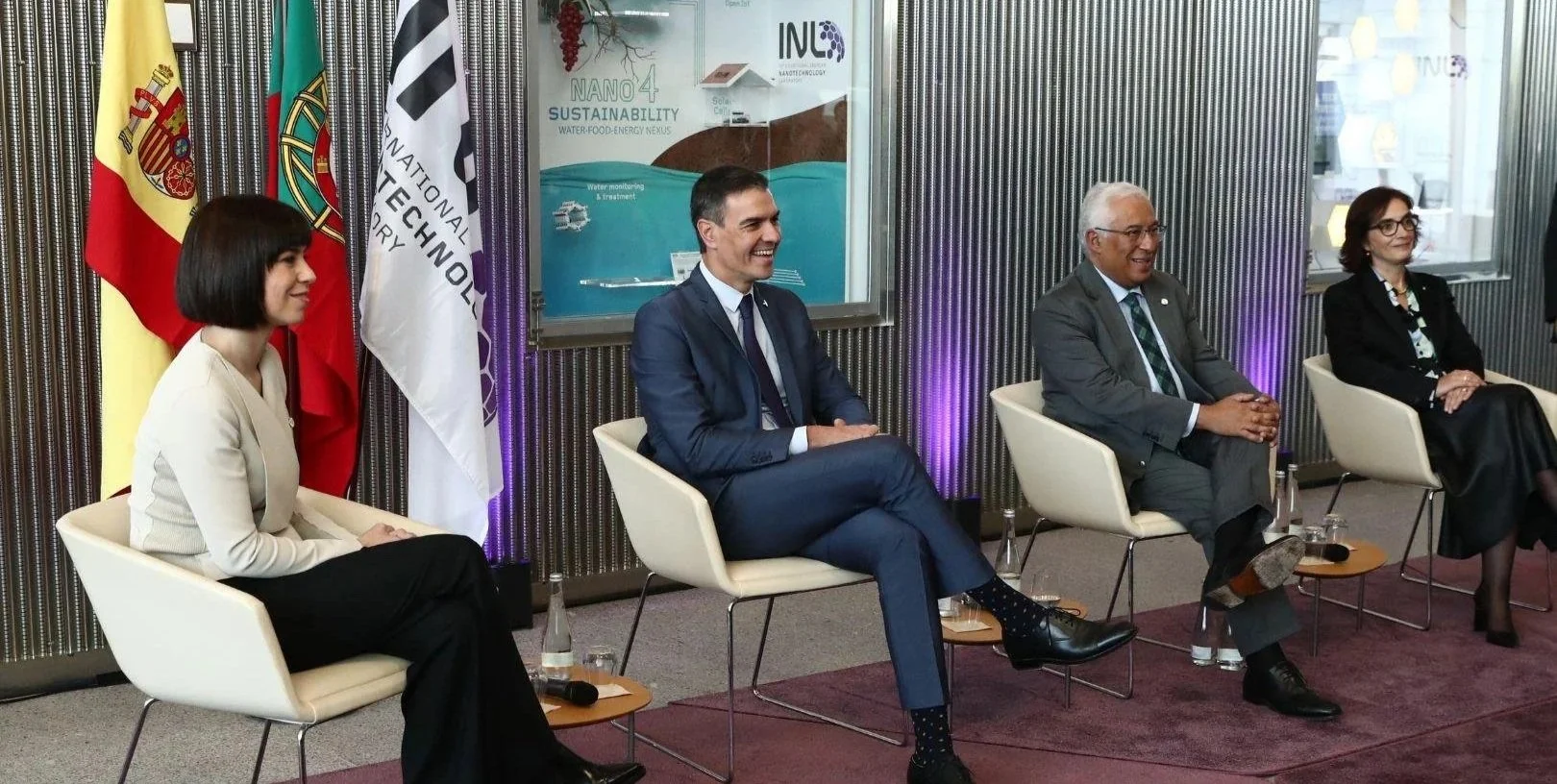
© Ministerio de Ciencia, Innovación y Universidades
From left: Spain's Minister of Science and Innovation Diana Morant, Spanish PM Pedro Sánchez, Portuguese PM António Costa, and Portugal's Minister of Science, Technology and Higher Education Elvira Fortunato at the signing of the Atlantic Constellation agreement, Viana do Castelo, November 2022
Why now
Technology catching up
A decade ago, a single Earth Observation satellite required hundreds of millions of euros and years of development. Today, compact multispectral cameras, on-board AI processors, and standardised small satellite platforms have brought the cost and timeline down by an order of magnitude. A 6U CubeSat, roughly the size of a shoebox, can now carry instruments that detect wildfires, monitor marine ecosystems, or track vessels in near-real time. This makes national space programmes accessible to a much wider group of countries than ever before.
The need for actionable data becoming urgent
Climate change, migration, maritime security, and natural disasters have created demand for frequent and independent access to Earth Observation data that cannot be met by just requesting access to other nations' satellites. Greece needs to monitor nearly 14,000 kilometres of coastline and thousands of islands. Portugal and Spain face Atlantic storm systems, wildfires, and frequent droughts. Copernicus provides global coverage, but its satellites follow fixed orbits and schedules, which means that when a wildfire breaks out on a Greek island or a storm hits the Portuguese coast, the data might not arrive quickly enough. National microsatellite programmes give these countries that capability.
The geopolitical context shifting
The war in Ukraine demonstrated the strategic value of satellite-based intelligence and communications. Europe's dependency on non-European providers for critical space services became a political liability. At the same time, EU recovery funds enabled space programmes to be financed under the umbrella of digital transformation and resilience, a framing that did not exist before the pandemic.
A new reality
National microsatellite programmes are not simply smaller versions of traditional space projects. They represent a fundamentally different model for how countries acquire space capabilities.
Domestic industry creation
In Greece, the programme goes beyond buying satellites. It is building facilities, training engineers, and establishing a domestic supply chain. Contracts are being structured to require local assembly, subsidiary creation, and technology transfer, so that each mission leaves behind industrial capability, not just hardware in orbit. Greek professionals who built careers abroad in European space companies are returning home to work on their own national programme. Portugal is doing the same, with plans for satellite assembly facilities on Portuguese soil. This talent repatriation and industrial development may ultimately be more valuable than the satellites themselves.
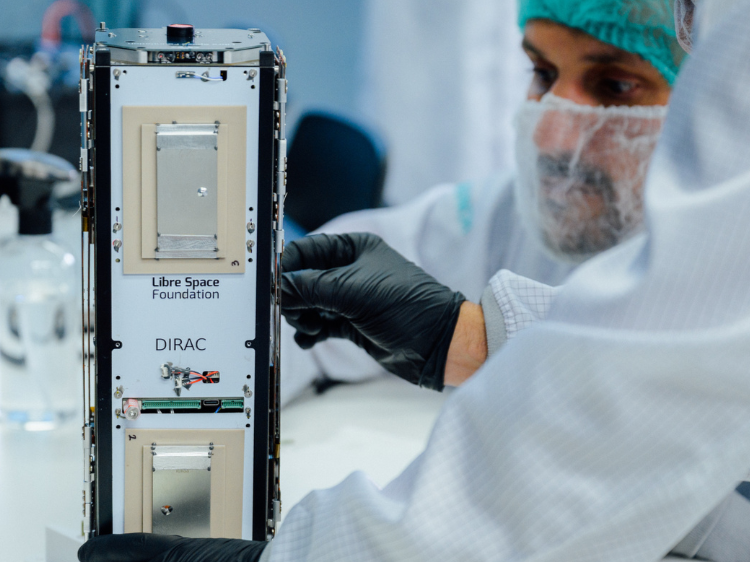
© Libre Space Foundation
An engineer handles PHASMA-DIRAC, a 3U CubeSat designed and built by the Libre Space Foundation in Athens. Launched in November 2025, the mission is part of Greece's national satellite programme.
Collaboration at a new scale
These programmes are designed around mutualised constellation models: shared satellite infrastructure where multiple countries contribute spacecraft and share access to the combined data. A country that puts two satellites into a constellation of twenty gets far more coverage than it could achieve alone. Greece's next satellites, for instance, are being built to be fully compatible with the Atlantic Constellation, creating the technical foundation for cross-border interoperability from the start. This pooled approach lowers the entry barrier for smaller nations while multiplying the value for all participants.
Immediate results
While Europe's larger programmes operate on decade-long timelines, national microsatellite programmes are launching within two to three years of contract signature. Greece went from programme design to operational satellites in just four years. For governments that need data for policy decisions today, not in 2030, this speed matters.
The broader significance
These programmes are quietly building something that Europe has lacked until now: a distributed layer of Earth Observation infrastructure, owned and run by the countries themselves.
And while this is not a replacement for Copernicus, which provides unparalleled open-access global data, nor a competitor to IRIS², which addresses secure communications, it achieves something neither of them was designed to do: localised, independent, and timely data that national governments can readily use for daily decision-making.
National microsatellite programmes are creating a new generation of space-capable nations within Europe. Greece, Spain, and Portugal are not buying satellite data. They are learning to build, launch, and operate satellites, and in doing so, developing the engineering talent, institutional knowledge, and industrial relationships that will serve them for decades.
What's next
The opportunity now is coordination. If these national constellations can share data, align ground segments, and operate as a distributed European network, they could provide something that no single programme, however well-funded, can deliver alone: resilient, multi-source, and sovereign Earth Observation coverage across the continent.
The technical groundwork is already being laid. Interoperability between national constellations is being designed into the satellites from the start, and ESA's role as contract manager for several of these programmes positions the agency as a natural coordinator. What is still missing is a formal framework: the agreements, standards, and structures that would allow these national satellites to work together as a European network when needed.
The countries building these programmes have shown they can move fast on their own. Doing it together is the next move.